Descend

The Lost Tapes of Doctor Michel Siffre
A Postmodern Chronicle of Isolation, Madness, & Savage Darkness
In the winter of 1972, esteemed French geologist and existential temporal theorist Dr. Michel Siffre descends alone into an uncharted cavern of the Midnight Caves, nestled in the limestone depths near Del Rio, Texas, a remote and rugged land where sun-scorched plains conceal a labyrinth of ancient subterranean chambers carved by water and time. His mission: to test the limits of human endurance and perception, cut off from all light and life. Armed only with basic rations, a recorder, and the raw machinery of his mind, Siffre plans to chronicle the slow erosion of his circadian rhythm and consciousness.
But what begins as a scientific endeavor soon warps into something far more terrifying.
As days bleed into nights and weeks spiral into oblivion, Siffre’s audio logs transform from careful observation into a harrowing descent through paranoia, existential dread, and spiritual collapse. He rages against the crushing void, mourns the fading memory of his young wife and beloved sister, and claws at the unraveling threads of meaning itself. Loneliness festers into delusion; the darkness becomes alive; and the philosopher’s quest for understanding mutates into a cursed pilgrimage into the raw marrow of human despair.
The tapes he left behind, recovered from a collapsed chamber and sealed away for decades, stand as both scientific relic and personal requiem. They form a nightmarish meditation on isolation, the fragility of the mind, and the dreadful possibility that the universe is not only silent, but hungry.
There are places beneath the earth where time distorts, where the mind frays, and where the abyss does not merely stare back ... it listens.
Step into the blackness.
Listen.
It is waiting.
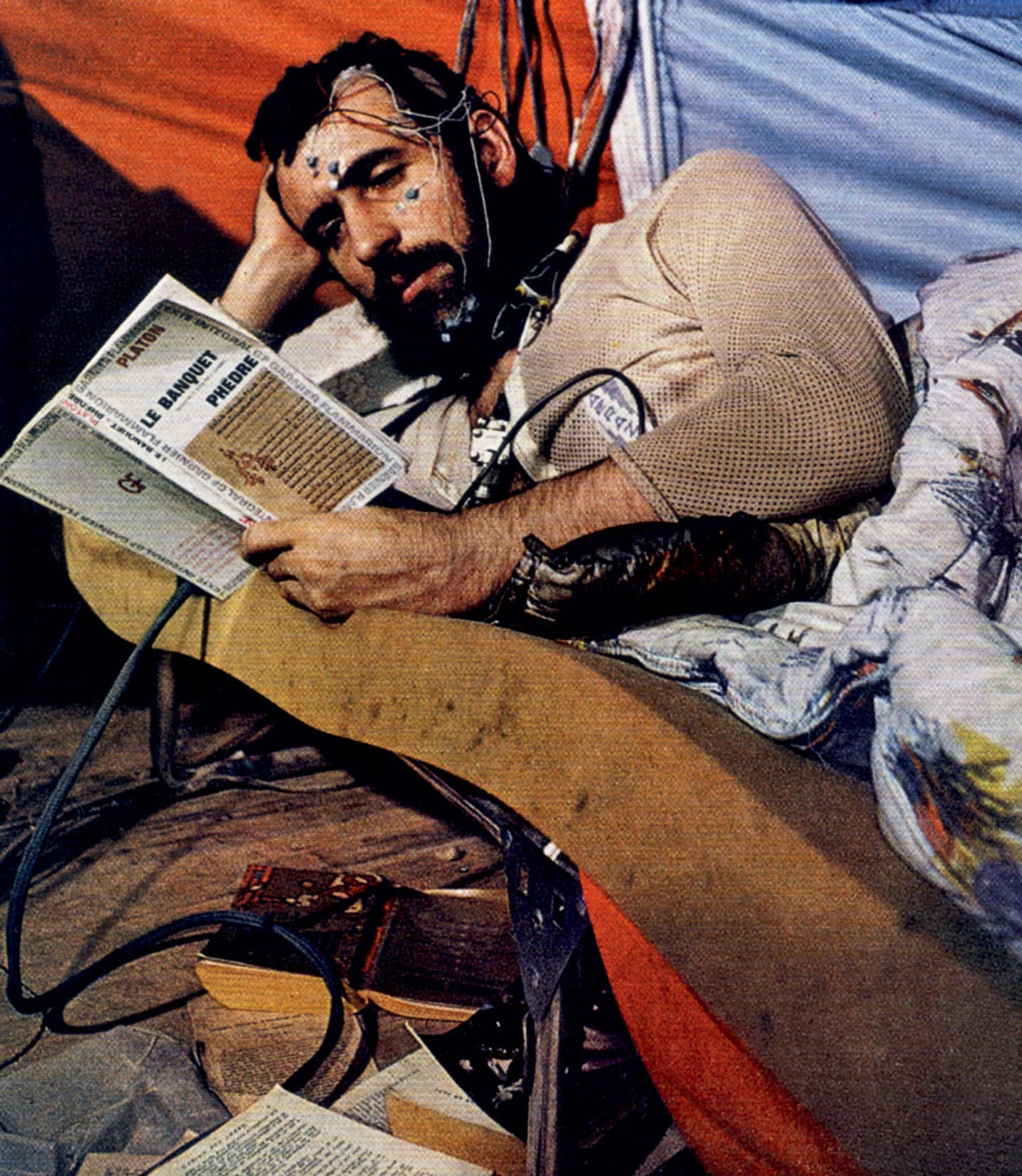
Historical Background of Dr Michel Siffre
Michel Siffre’s 1972 Cave Experiment
In the shadow of the Cold War and on the frontier of human endurance, French chronobiologist Michel Siffre embarked on a terrifying and unprecedented experiment that would stretch the limits of human sanity. The year was 1972, and Siffre, already known for his 1962 descent into a glacial cave in the French Alps, chose a darker, hotter, and far more unforgiving tomb for his second study: a cavern outside Midland, Texas.
The descent began at 10am on February 13, 1972. Just one day before Valentine’s Day. While lovers above exchanged roses and wine, Siffre began to experience the first impacts of being hundreds of feet beneath the Earth’s surface into a hellish pocket of black limestone.
The air was hot and wet, thick with humidity and silence. Black dust clung to his clothes, his skin, his lungs. There was no light. No clocks. No human contact … only a reel-to-reel audio recorder to record his voice logs.
Those logs (fractured, surreal, and agonizing) would form the basis of “The Lost Tapes of Michel Siffre,” recovered many years later.
Backed by NASA and the U.S. Navy, the experiment aimed to study the effects of prolonged isolation on circadian rhythms and human cognition.
But Siffre was not prepared for the obliteration of time itself. Within weeks, his internal clock began to unravel. He stayed awake for stretches lasting 36, sometimes 48 hours. He couldn’t tell if he was dreaming or waking. The darkness swallowed all rhythm, all sense of forward motion. The days didn’t pass … they folded.
By Day 100, his mind had begun to fracture. He reported hearing voices. Memory lapses became common. He would forget whether he had eaten. His language deteriorated. At one point, he spoke tenderly to a rat that had burrowed into his sleeping bag, only to scream for hours when it died. “I am no longer a man,” he said in one garbled log. “Only the body of one.”
The final recordings are scattered and cryptic. Long silences. Repeated words. Nonsense syllables. Then, nothing.
His body was never recovered.
Only the tapes remained, discovered decades later, buried in archival dust, stitched together by researchers and historians. The book that followed, “The Lost Tapes of Michel Siffre,” is less a scientific document than a ghost story. A man’s voice, alone in the dark, trying to hold on to reason, to memory, to the last flickering sense of self.
He went into the earth to study time. But what he found was something far more terrifying: its absence.
Read the detailed transcripts of his time alone in the dark in “The Lost Tapes of Doctor Michel Siffre”

About The Author
Introducing Sean Dempsey
Sean Dempsey is an American author and biographer whose work explores the strange, consequential, and often overlooked lives of real people. The author of more than twelve books, Dempsey writes across biography, narrative nonfiction, history, philosophy, and literary fiction, with a particular fascination for individuals whose lives reveal something larger about the institutions and cultures surrounding them.
His books include I Am William Woods: The True Story of the Man Imprisoned for Insisting He Was Himself, The Lost Tapes of Doctor Michel Siffre, and Dead Stars Shine Brightest: A Reckoning in Uvalde, Texas. His biographical work combines extensive research with the pacing and narrative techniques of literary fiction while remaining grounded in the historical record.
Across his work, Dempsey is drawn less to famous people than to human beings worth remembering, particularly those whose remarkable stories might otherwise be misunderstood, forgotten, or lost.
TESTIMONIAL
Reader Reviews
In “The Lost Tapes of Michel Siffre,” Dempsey achieves something extraordinary: he transforms a little-known scientific experiment into a mythic, terrifying odyssey. With precision, empathy, and a deft philosophical touch, he guides the reader through the claustrophobic corridors of both the physical cave and the mind itself. This is storytelling at its highest form: meticulously researched, masterfully paced, and emotionally devastating. Dempsey doesn’t just recount Siffre’s journey; he immerses us in it, forcing us to confront the deepest corners of human loneliness. An unforgettable triumph.”
- Jason Bergeron
“Absolutely breathtaking! The Lost Tapes of Michel Siffre by Dempsey is hands-down one of the most gripping and original books I’ve read in years. It reads like a psychological thriller, a horror novel, and a philosophical treatise all rolled into one. I couldn’t put it down. Every chapter pulled me deeper into the abyss. Dempsey brings Siffre to life so vividly that I actually felt like I was trapped underground with him, grappling with madness, memory, and the meaning of existence. If you love stories that make you think and send chills down your spine, you NEED to read this book!
- Thomas Peterson
“A rare fusion of scientific wonder and psychological dread. Dempsey captures the soul of madness in a cave of endless night.”
- anonymous
“Not just a story. This is a harrowing journey into the abyss of human endurance and despair!”
- Jon